13th February 2026
Cheese Stories
German version
A day with Ned Palmer in London's cheese paradise
This Cheese Story is based on a day spent with British cheese historian and author Ned Palmer in London. Together, we visit cheese shops between London Bridge and Borough Market – places where cheese becomes a seismograph of British history: mining, bans, raw milk debates, renaissance. A report on origins and the question of how British cheese traditions are being kept alive by cheesemongers and makers in the here and now – for example at Fen Farm Dairy or White Lake Cheese.
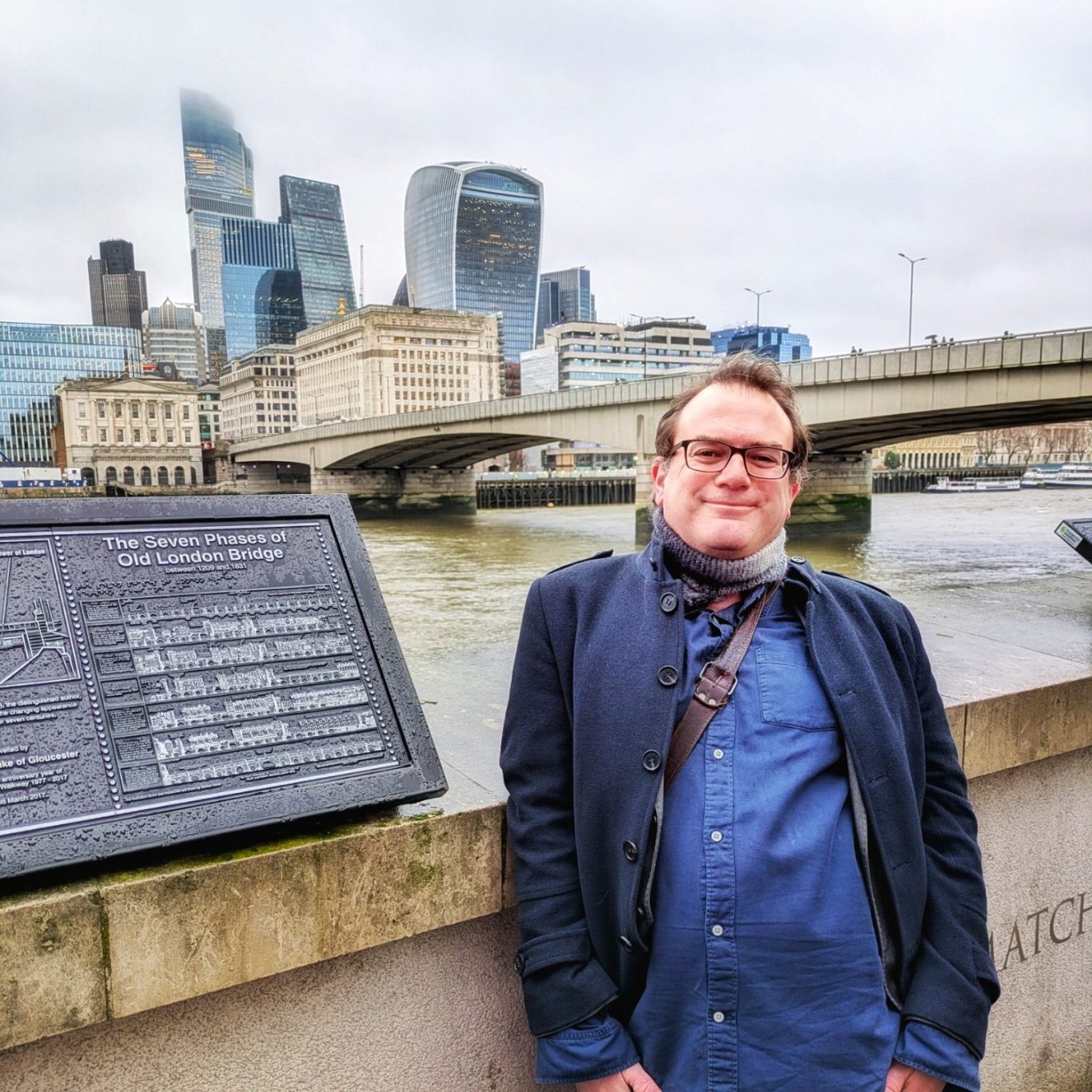
"There is no place where London's trading history and today's cheese world in the United Kingdom are so concentrated." 53-year-old Ned Palmer on Minerva Square – between London Bridge and Borough Market.
The fact that Ned Palmer has asked me to meet him here, of all places, is probably not just because of the spectacular view of London Bridge, I think to myself as I arrive at Minerva Square shortly before eleven o'clock – a little too early. Ahead of me lies a day with the 53-year-old London cheese expert and bestselling author, which I kicked off in style early this morning with a visit to the royal purveyor and the city's oldest cheese shop, Paxton & Whitfield, serving Her Majesty since 1850. Now I'm waiting between the Thames, Borough Market and the Golden Hinde for my friend Ned. A walking encyclopaedia of history. Hard to stop. His passion for cheese: highly contagious!
We met last year at the cheese festival in my hometown, Cheese Berlin, and couldn't stop chatting even here. Our deal when we parted ways: I promised him a visit to his home in the near future. In return, he promised me an unforgettable day in the cheese paradise of London. How right he was.
A Welsh icon
And here I am now. As I study the ‘7 Phases of Old London Bridge’ on a postcard, Ned arrives: casual jacket, tousled hair, a small neckerchief tied in a knot. We couldn't be dressed more differently. At a brisk two degrees Celsius, I'm wrapped up like I'm on a skiing holiday. Ned, on the other hand, defies the cold and wet with pure drive. Umbrella? He doesn't have one. ‘I've brought us some cheese,’ he says. ‘Want to guess which one?’
I have a hunch. Not least after reading his books, especially A Cheesemonger's History of the British Isles. Of course, he has lovingly portioned pieces of the cheese that once led him on his personal cheese journey: Caerphilly, a Welsh icon. The cheese that started it all for him.
Ned describes his personal moment more than twenty-five years ago as enlightenment. Understandable. Because this historic semi-hard cheese, whose origins date back to 1882 in the south Welsh village of Caerphilly, impresses on so many levels. It was first created as a cheese for everyday use on farms, then gained cultural significance in the Welsh coal mining industry, which has shaped the south of Wales since the beginning of industrialisation. For the miners, Caerphilly was affordable, easy to transport and nutritious: rich in protein and calories, yet salty enough to compensate for the mineral loss during long shifts. The rind, sprinkled with flour or oats, made it edible even with soot-stained hands. Wrapped in cabbage leaves, the workers took it underground with them, believing that it could at least partially neutralise the pollutants they inhaled.
During the Second World War, the production of almost all British cheeses except Cheddar was effectively banned. Milk was rationed, and the government focused on standardised products with a longer shelf life. For Caerphilly, this meant the end: production came to a virtual standstill nationwide, and traditional craftsmanship was lost. After the war, large dairies began to switch back to Caerphilly in isolated cases – mainly because of its shorter maturation time compared to Cheddar. More cheese, sold faster. But the Caerphilly of the post-war decades was an industrial product, far removed from its origins.
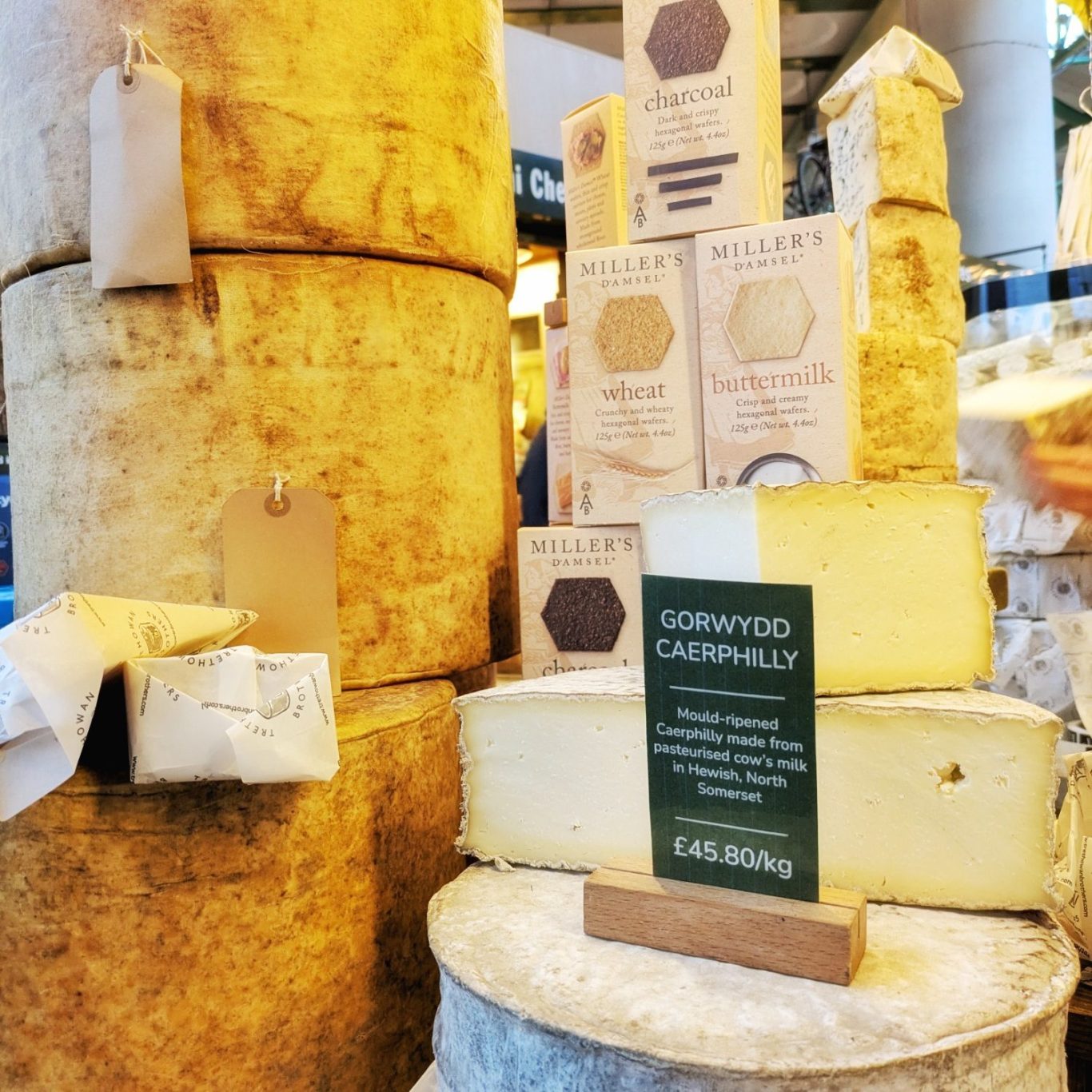
Caerphilly, the Welsh cheese icon: representative of the British cheese renaissance since 1996 thanks to the Trethowan Brothers.
It was not until 1996 that the Trethowan Brothers began producing Caerphilly cheese by hand. Todd Trethowan sold his Caerphilly at Borough Market. On that day of enlightenment in 2000, his friend Ned was there to support him. Until then, Ned had been familiar mainly with industrial cheese – and after his first taste of Caerphilly, he fell head over heels in love. He asked questions, lots of questions, until Todd finally got him a job at Neal's Yard Dairy.
And now Ned and I are leaning against the Thames embankment, savouring this piece of British cheese renaissance: made from raw milk, lemony, buttery, earthy. The centre is moist and crumbly, the edges increasingly creamy, enveloped in a grey-white mould rind with the feel of soft felt. With these flavours on my tongue, it's easy to understand Ned's enlightenment twenty-five years ago.
No bridge, no market
‘So why did you ask me to come here of all places?’ Ned smiles. The starting gun has been fired, and I know that it will be almost impossible to interrupt him for the next few hours. ‘There's no other place where London's trading history and today's cheese world in the United Kingdom are so concentrated,’ he says. For centuries in the Middle Ages, London Bridge was the only permanent crossing over the Thames. The first stone bridge was built here in 1209 – unlike today, it was a lively, almost overcrowded place with shops, apartments, market stalls and even a church. ‘It must have been incredibly crowded,’ says Ned, ‘and it probably smelled great, like cheese.’
It wasn't until 1750 that Westminster Bridge was added. And with it came movement into the city. In 1761, it was time for a makeover of London Bridge. Shops and houses disappeared. What remained was a rather fragile structure, which was replaced by New London Bridge in 1831. This is just a brief overview of the history of London that surrounds us, which Ned skilfully enriches with delicious cheese anecdotes.
For centuries, London Bridge was the only connection from the south – traders, pilgrims and cattle drivers passed through here. Where they arrived – on the south side of the Thames in Southwark – market life sprang up. The beginnings of today's Borough Market took shape as a bridge forecourt: a place of supply for travellers and for the city itself. Without the bridge, there would be no market.
Lactic, sharp, magnificant!
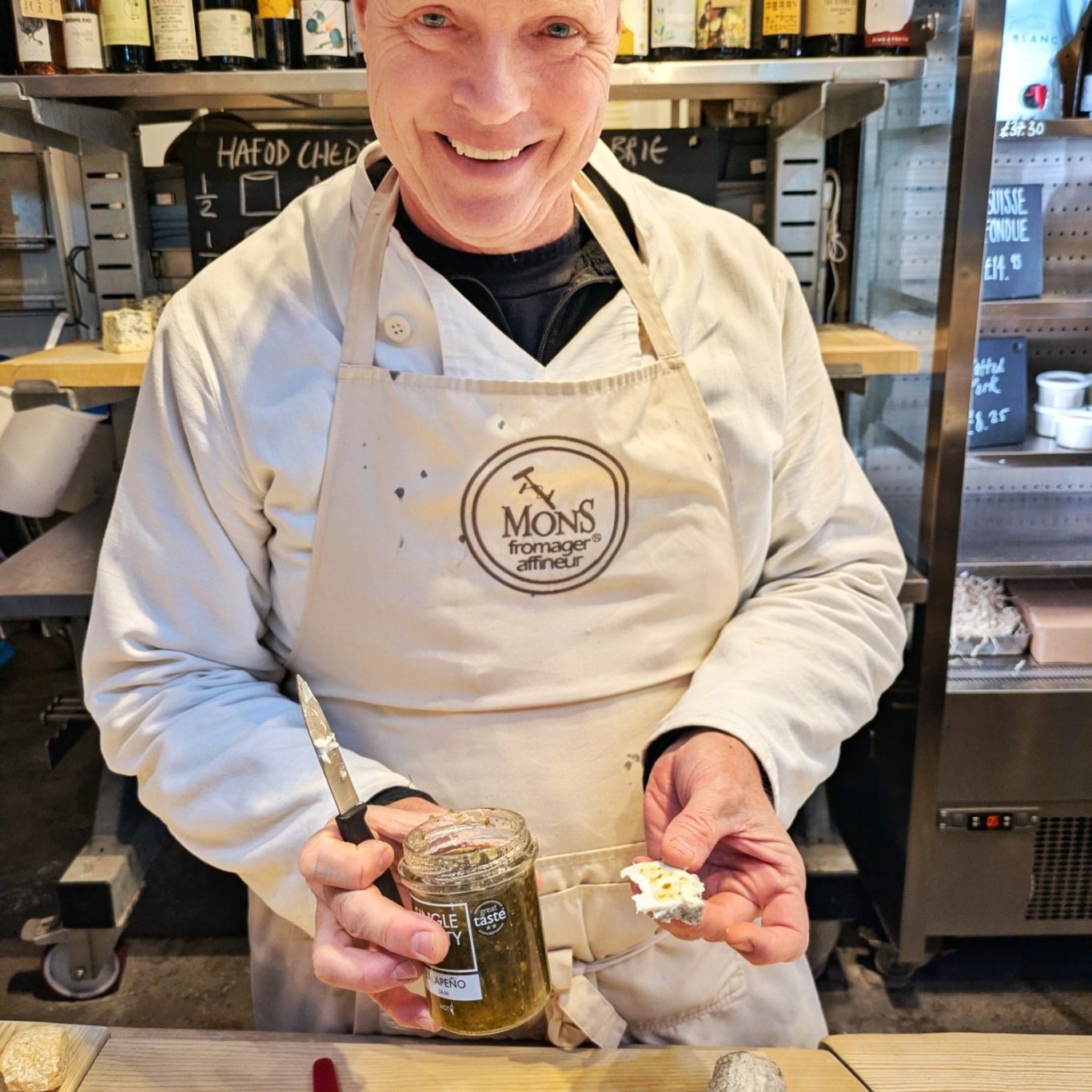
Michael Finnerty, author and cheesemonger at Borough Market's Mons stall since 2019, surprises with skilful pairings.
Located at its current site in Southwark since 1756, Borough Market became a wholesale market in the 20th century. Today, it is a culinary and cultural centre for delicatessens, retailers and manufacturers. And our next destination. We leave Southwark Cathedral, located on the site of the original Globe Theatre where William Shakespeare worked, to our right. ‘Shakespeare must have had a strange relationship with cheese,’ Ned murmurs. A few seconds later, we are enveloped by the unique aroma of Borough Market: a blend of coffee specialities, chickpea stews and cheese delights that you probably won't find anywhere else.
‘Ned, Laura!’ Our mutual friend and author Michael Finnerty calls out to us – he is currently working a shift at the Mons Cheesemongers stand, which specialises in high-quality French and Swiss cheeses. ‘Great to see you. Wait – you have to try this!’ We have only walked a few metres and are already tasting an ash-matured raw milk goat's cheese from the Loire: Selles-sur-Couffy, related to the better-known Selles-sur-Cher. Michael, who has been with Mons for over six years, skilfully pairs this lactic, delicately sour cheese with a strong, spicy jalapeño jam from a manufacturer in Bristol. Magnificent!
Mons opened in Borough Market in 2006 and is known for its artisan cheeses, which are matured in its own cellars in London and France. It was founded by renowned affineur Hervé Mons. A truly impressive repertoire. And that's why, of course, we won't be stopping at just this one sample.
‘Always Team Caerphilly’
It's not even one o'clock, and after just our first stop at Borough Market, Ned and I are already carrying around a noticeable ‘cheese belly’. And we're only just heading for the Trethowan Brothers' stall – the place where Ned had his epiphany twenty-five years ago.
I try to hold him back briefly, suggesting a quick detour to JUMI, the small offshoot of the Swiss cheese universe that took root here in 2015. In vain. Ned is unstoppable. He is magically drawn to the almost spartan-looking wooden stall with its yellow plastic roof and the sign ‘Somerset Cheddar Maker’. Wait a minute. Aren't we actually talking about Caerphilly from South Wales?
‘Yes, it's a funny story, right?’ Ned recounts how his friend Todd gave up studying archaeology to learn from Chris Duckett, one of the remaining artisan Caerphilly producers. Together with his brother Maugan, he developed the original recipe using unprocessed milk into Gorwydd Caerphilly, named after the settlement where the two lived. Dissatisfied with the quality of milk in their region, they finally moved production to Somerset in 2014 – to protect the quality of their Gorwydd Caerphilly. In 2017, his big brother, the multi-award-winning Pitchfork Cheddar, joined the range. ‘I love both,’ says Ned with his mouth full, ‘but I will always be in team Caerphilly.’
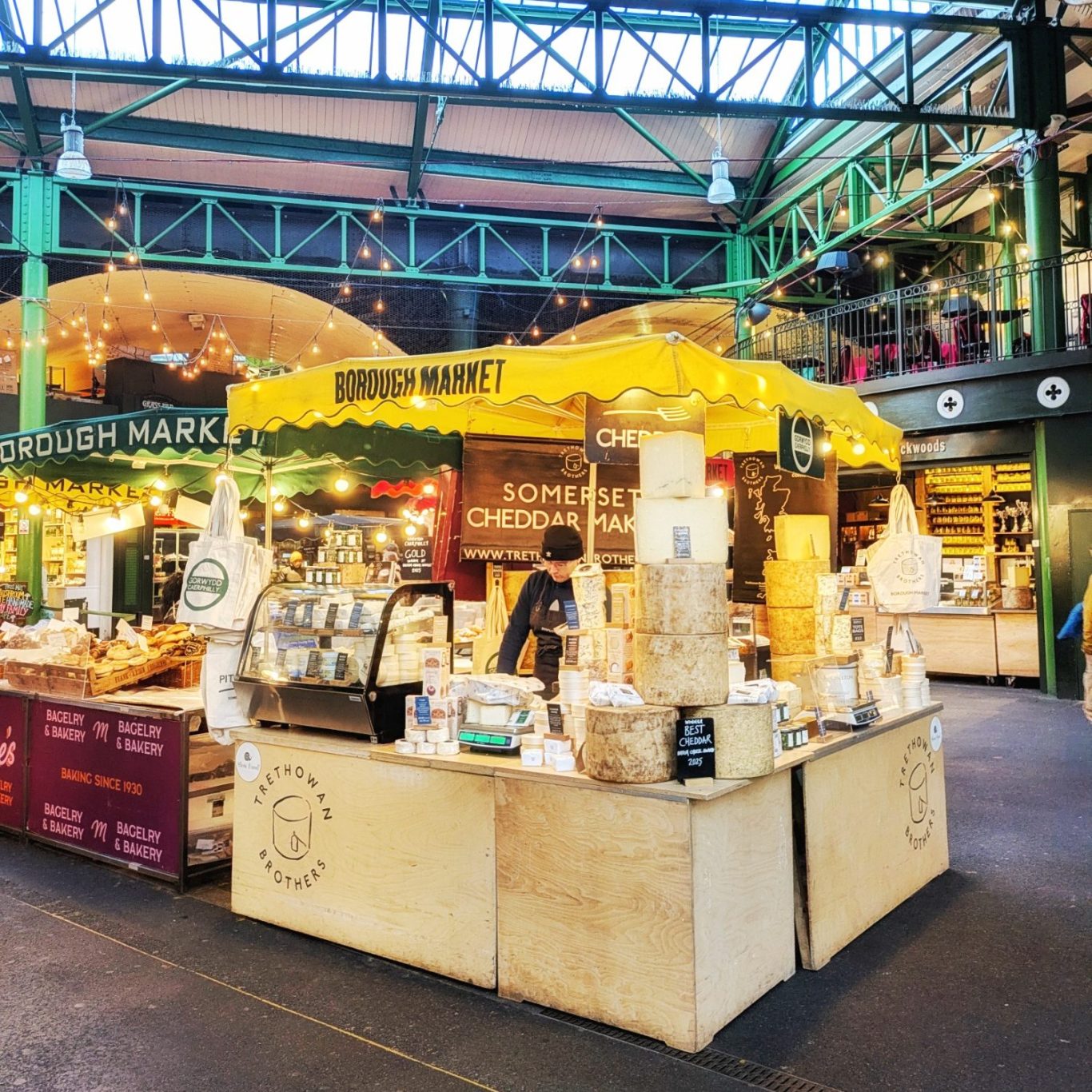
2020, the site of Ned's Caerphilly enlightenment: the Trethowan Brothers' stall at Borough Market.
A more than committed culture
Ned asks whether there is actually an equivalent to the expression ‘you are a big cheese’ in German. ‘Not really,’ I reply. But here it's a big compliment, isn't it? ‘Oh yes,’ he says, as we look up at the stacked cheddar wheels at the Trethowan Brothers stand. ‘It means you're a really big deal.’ Ned worked at this stall for two years before Todd got him a job as a cheese merchant at Neal's Yard Dairy – our next stop.
Neal's Yard Dairy opened its first store in Covent Garden in 1979 with no less than the ambition of saving British cheese culture. Owner Randolph Hodgson insisted that the focus should be on british cheese. Through uncompromising quality standards, close relationships with producers, its own affinage and clear differentiation from industrial products, Neal's Yard Dairy became a hub of the British cheese renaissance. In 1998, they opened the wholesale business in the building that now houses the shop – just a stone's throw away on Park Street.
We briefly pass the Kappacasein stand with the ‘best grilled cheese sandwiches in town’. With every metre we walk, it becomes clearer that I am out and about with a London cheese celebrity. Every person who steps out of the cheese-yellow interior of Neal's Yard Dairy with a happy face becomes part of a short conversation.
‘Ned, what's going on? Loved your article!’
‘Oh, Ned, nice to see you. How are you?’
‘Ned, see you tomorrow evening at the cheesemonger night?’
He initiated the latter a few months ago together with Hero Hirsh: a regulars' table for the cheese scene. ‘From curd to counter’: a living cheese culture that Berlin can be envious of.
Inside, we taste our way across the cheese map of Great Britain. Ned stops for a quick expert chat with a former colleague: ‘Whether I would really be able to taste the sting in a blind tasting...’ And I assume that this stop is the last of a more than unforgettable day in the cheese paradise that is London. How wrong I am.
‘I have another surprise for you!’
A delicious journey through time
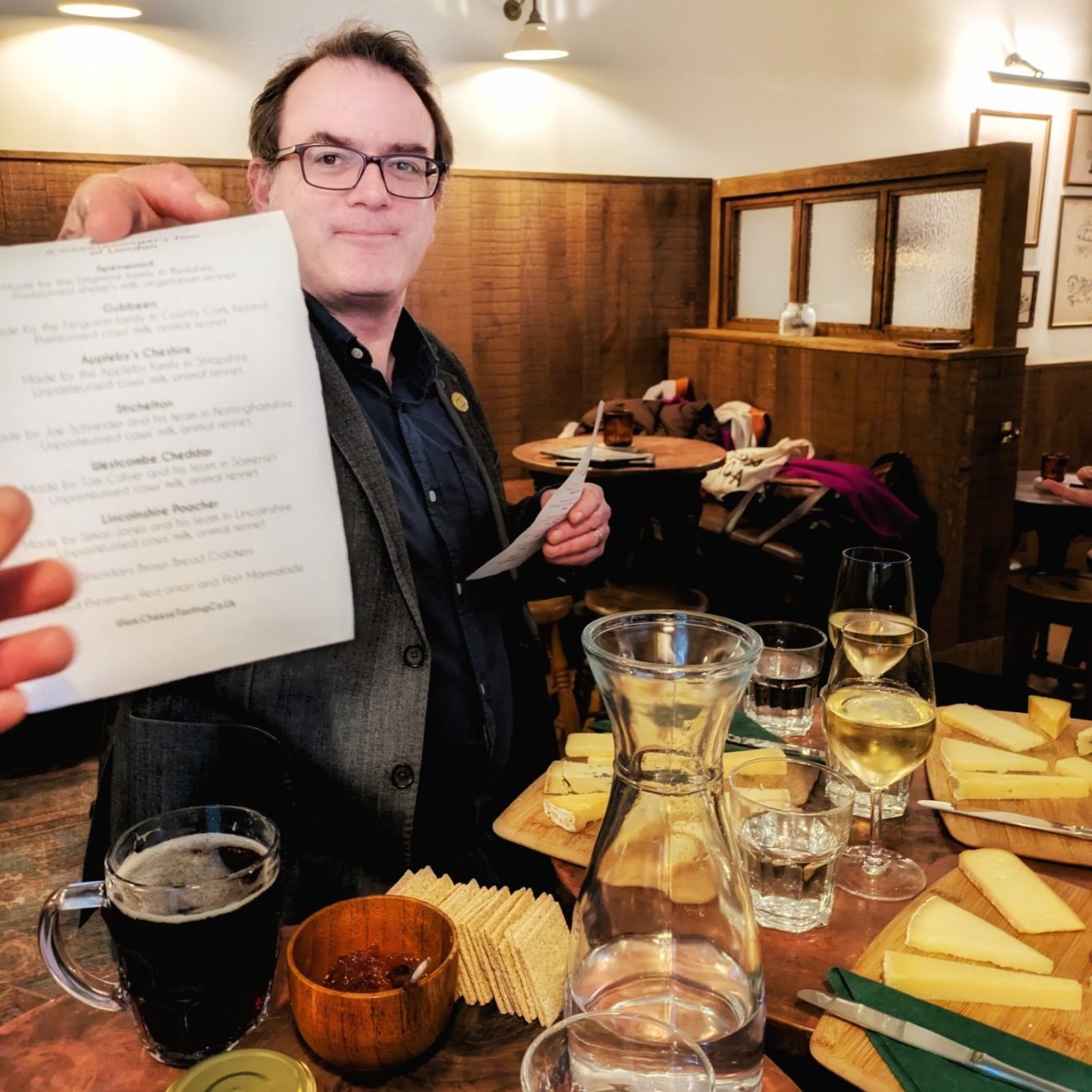
A delicious cheese journey through British cheese history at the historic Blue Maid pub.
A mischievous smile, a short walk – and I'm sitting with Ned at The Blue Maid, a classic bitter in front of me. And, of course, this pub also has a history: its location can be traced back to the 16th century and it appears in literature, for example in Charles Dickens' Little Dorrit. But the biggest story is happening right now. Next to my pint, I discover a lovingly compiled menu. Ned has prepared a tasting – following the chapters of his book on British cheese history. Chronologically. With great care. Magnificent!
The tasting begins with a Spenwood from the Wigmore family in Berkshire: a hard cheese made from sheep's milk, nutty, with sweet and savoury notes and a smooth texture. It represents the Roman chapter. This is no coincidence: Berkshire lies at the heart of Roman Britain, and hard cheese made from sheep's milk like this was intended to supply the legionaries.
This is just the beginning of a journey through six historical stages, each accompanied by the appropriate type of beer. For Stichelton – we are now in the 18th century, the time when Stilton was created – Ned orders a strong pale ale. Anyone familiar with the Stilton and porter duo will love Stichelton and pale ale!
Tradition is odd
And, of course, he cannot avoid highlighting the work of Stichelton Dairy, which has had such a formative influence on contemporary British cheese culture. Background: According to the terms of its PDO, which Stilton makers registered in 1996, Stilton producers are now required to pasteurise their milk. Joe Schneider of Welbeck Estate in Nottinghamshire did not want to see the original Stilton recipe using raw milk fall into oblivion.
Since 2006, on the northern border of Sherwood Forest, he has been processing the milk from his organically raised cows into a raw milk cheese of incomparable depth and elegance. He was not allowed to call it Stilton. So Joe had to resort to the even more apt name Stichelton – as the village of Stilton was called several centuries ago. His cheese has since earned a great reputation. And at this moment, it melts on my tongue with the sweet notes of the ale.
This question is actually purely rhetorical. So I am all the more surprised when Ned answers how he feels about traditional craftsmanship: ‘The idea of tradition is strange. I really appreciate young cheesemongers – they leave the cage of geographically protected specifications and create something new.’
This progressive idea leads us to the final cheese of the tasting: a Lincolnshire Poacher from Tom and Simon Jones. A mature hard cheese, somewhere between Cheddar and Alpine mountain cheese. Accompanied by a malty, deep black porter. A crowning finale on the palate – and for Ned, a reflection of contemporary British cheese culture: open to the world, rooted in the local terroir, refined, high-quality, bold. ‘Another perfect example,’ he says, ‘would be the Baron Bigod from the Fen Farm Dairy.’
A big cheese
‘So where are we going now?’ Ned Palmer suddenly asks me, still full of energy. I look at him in disbelief. Outside, the sun has long since set. It feels like a lifetime has passed since we met at Minerva Square this morning: we've journeyed through stages of his life, hugged cheese faces, shared knowledge, and polished off a good two kilos of cheese per person.
Twenty-five years ago, he had his Caerphilly epiphany at Borough Market next door. A moment, an energy that seems to linger to this day. Ned's knowledge, his infectious enthusiasm, his wealth of experience seem simply boundless.
Once again, he asks, ‘What shall we do now?’
I smile, give him a big hug and whisper in his ear, ‘Ned, you are a big cheese.’
This encounter is part of my ongoing Cheese Stories about international cheese cultures.