12th February 2026
Cheese Stories
German version
In the heart of Somerset: Roger Longman's White Lake Cheeses
This Cheese Story is based on a visit to Roger Longman of White Lake Cheese in Somerset. It focuses on a strong-willed entrepreneur who broke away from the traditional Cheddar of his region and instead began producing modern British goat's cheese, among other things. Together with the Cheese Story about Jonny Crickmore, the report shows how a young generation of cheesemakers in England is putting down new roots.
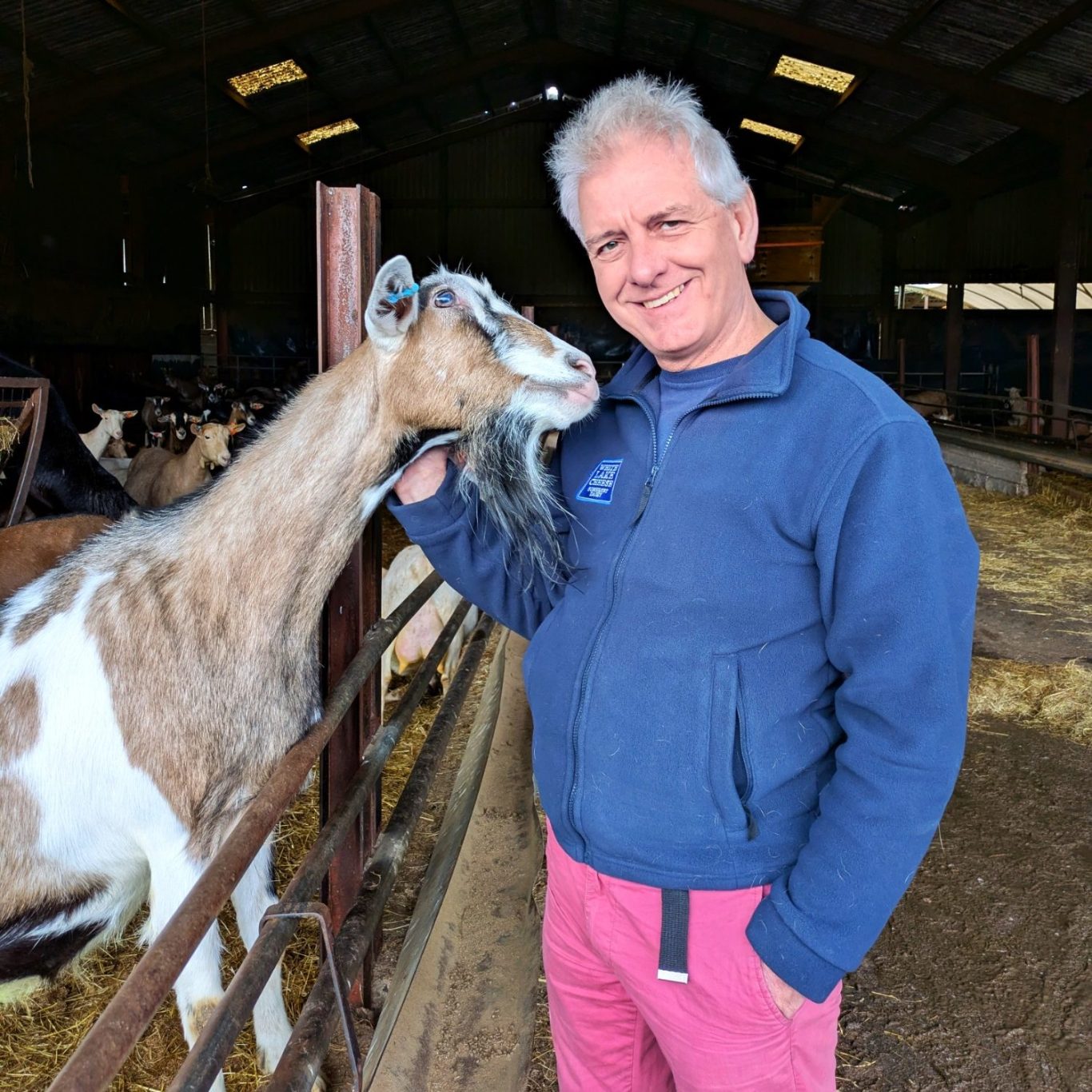
58-year-old Roger Longman with his favourite goat, Whisper: "Goats are really very good listeners."
The land of summer settlers: the English county of Somerset – known for its craft cider and cheddar. Names like Westcombe, Keen's and Montgomery are within a twenty-mile radius of Castle Cary station when I arrive. I'm in the heart of British cheese country. This is where Somerset's heart beats.
But Roger Longman no longer wanted to play along. Before he started making cheese himself in 2004, he actually had completely different plans. He never wanted to return to his parents' farm in Pylle, where traditional Cheddar had been made with forty cows since the 1930s. ‘But I was never interested in cows,’ he says. One of the first things he says in the car when he picks me up from the station.
On the way to Bagborough Farm, the 58-year-old tells me why he initially turned his back on the place of his childhood. He wanted to become an engineer, to lead a life beyond cows. It was only when his parents retired that he was drawn back. Third generation, but only on his terms. He wanted to create something of his own, contrary to the traditional path of his parents, different from the Cheddar families around him. So it was cows out, goats in. ‘I had to teach myself everything from scratch,’ he says. ‘Fantastic, isn't it?’
Stubborn, inquisitive, going against the grain – this becomes apparent within the first few minutes of our encounter. ‘I don't have a plan B,’ he says. ‘The first four years were nothing but losses. It took us another four years to make up for that. Only then did we start making money.’ He says he's still a bit of an engineer. ‘If something doesn't work, I find a way.’
Creative, solution-oriented, always beaming: ‘I am a proud Somerset guy!’ Roger Longman is a British character. A unique individual who has helped shape the artisan cheese scene in the United Kingdom with his award-winning goat's cheeses. 22 years of White Lake Cheese. And still hungry to create something new.
Crazy visions
His parents' house, cheese dairy, maturing rooms – everything is in one place here. Only the herd of goats, currently numbering around 600, is half a mile away. The car doors have barely closed when Roger Longman appears in front of the house in the bright sunshine: broad-shouldered, steady. This is where he grew up. Even back then, cheese production and everyday family life were inextricably linked. ‘As a little boy, I used to trip over our cheddar wheels here,’ he calls out to me as we walk past – on the way to what is now the cheese dairy.
It became clear during my research that this place follows its own rules. Unlike Errington Farm, for example, which also focuses on artisan goat's cheese, Roger emphasises diversity rather than a clear line. Rachel, Driftwood, Solstice, Tor, Pavé Cobble, Bagborough Brie: his current cheese repertoire comprises 22 varieties – and growing.
‘It's just fun,’ he says almost casually as we stand in the six-degree cold storage rooms. I look around in disbelief and ask why he puts himself through this diversity – and whether it isn't exhausting. He laughs and waves it off: ‘Not for me. I'm good at initiating new things, and I have a team around me that shares this attitude. They take my crazy visions and bring them to life.’
An extended family full of cheese
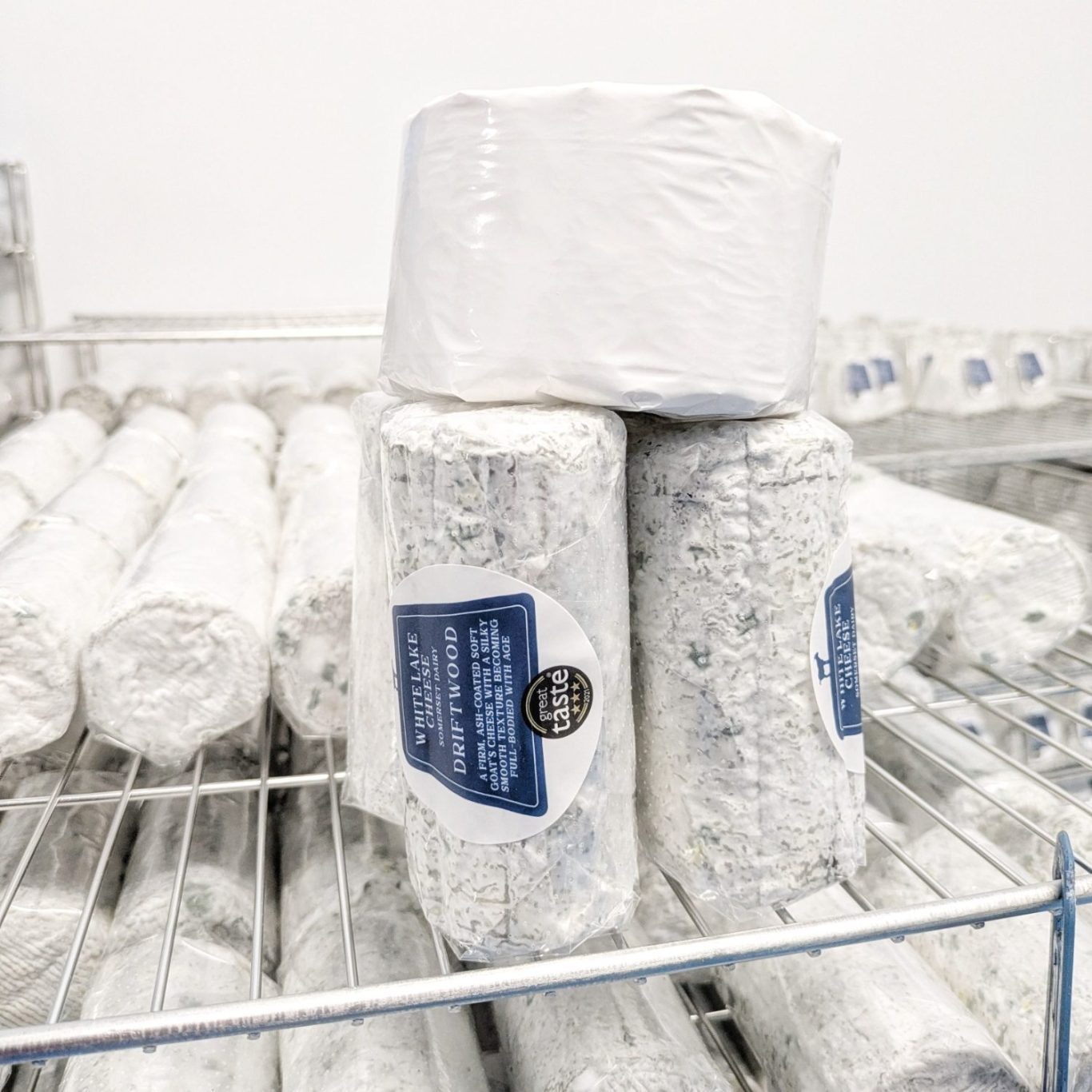
Four driftwoods, crowned by a White Nancy: "Will you marry me?"
And, of course, there are classics right from the start. Or those that are well on their way to becoming classics. He proudly holds a wrapped loaf of Rachel under my nose – a semi-firm goat's cheese with a red smear rind in the Gouda style: milky-sweet, aromatically rounded, a crowd favourite from the start. ‘Did you know that here in England, many couples opt for a cheesy interpretation instead of the classic wedding cake?’ Hands-on as he is, he immediately arranges four Driftwoods, topped with a White Nancy (how fitting!), into a cake. ‘Will you marry me?’
Fun is the main focus here. I can see that in the faces of the fifteen-strong team I meet in the picking, cheese-making, maturing and packaging departments. ‘We are just happy,’ says someone in passing. To create this large cheese family, it has to feel like a family here. And as different as the varieties are, they all have one thing in common: they were created out of pure joy.
And it's no big secret how this diversity is possible. ‘Of course we need enough milk from the ladies,’ he says with a smile. But in addition to a sufficient amount of milk, what is needed above all is structure, a functioning system, clear processes – and quite a few cheese moulds of different sizes. ‘Many other cheesemakers have wanted to copy this.’ A few years ago, Yule and Paul from Urstrom were also here.
‘A lovely world’
Roger not only loves sharing his knowledge of cheese – he is also driven by his own desire to learn. That's why he travels a lot – most recently to France. His mission just under two years ago: to understand how to make lactic cheese properly. Less moisture, warmer maturation, salt added directly to the milk. With his creation, a pyramid-shaped goat's milk cheese with a firm texture, the Geotrichum candidum can work better – and the result is more consistent.
His constant drive to develop himself and his cheeses impresses me. ‘You can read about these things in books, but you only really understand them when you talk to other people on site.’ So, as we watch Oliver rubbing salt water into the English Pecorino in the affinage, I ask him what he wants to focus on next.
‘I really need to go to Switzerland!’ he exclaims. Last summer, his cheesemaker Rosalind went on a study trip to the canton of Voud – the knowledge she brought back with her still makes him envious. Since then, they have been experimenting with an ‘Alpine Style’ cheese. And anyway, he can even find cheese farms in Mumbai. It's just great how much the world of cheese connects people around the globe. ‘It's a lovely world, right?’
Diversity without compromising quality
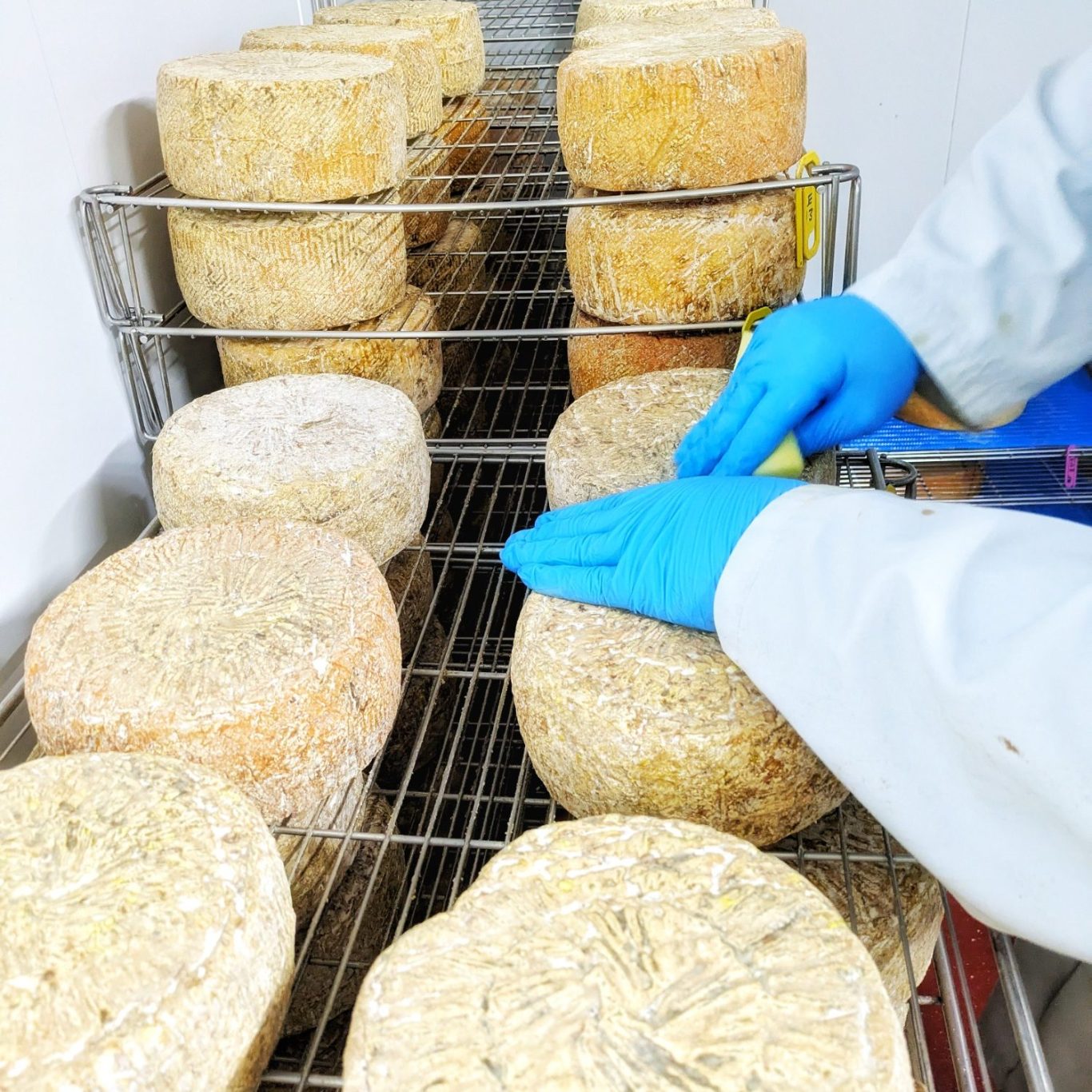
Affineur Oliver caring for the English interpretation of a Pecorino.
These are by no means the only goals for this year. For the first time, the company plans to produce marinated feta cheese. Roger also wants to expand cooperation with retailers again. After all, they are first and foremost ‘cheesemakers, not a distribution company’. If only because it's no fun supplying individual private customers with such a wide variety of products. It makes more sense to exploit the full potential of wholesalers – and to develop new cheeses for Waitrose, Marks & Spencer and Co.
We take off our protective coats and hairnets. ‘You know, no matter how many varieties I create, each one has to be convincing in terms of quality, name and history. Despite all my stubbornness, I have inherited a great legacy. And I want to represent my region with my name and the names of my cheeses to the best of my knowledge and belief.’
Black tea with milk
As sunny as this Thursday afternoon in mid-January may be, we are now frozen through. ‘A hot cup of tea is never a bad idea.’ After being greeted enthusiastically by Brie, a two-year-old Labrador, we sit down on the corner bench in his kitchen. A few moments later, two large mugs of black tea appear on the table. With milk – without milk is not an option here in Somerset.
I return to the subject of cultural heritage and ask what comes to mind when I mention the phrase ‘traditional British cheese’. ‘Cheddar.’ So he doesn't follow traditional craftsmanship? ‘Oh god, no!’ But he likes traditions? ‘I love them.’ Then why doesn't he produce traditional cheese himself, I ask. Roger takes a big sip of tea and smiles: ‘Others are simply better at it than I am. Take French cheese traditions, for example. They've been alive for decades – if not longer.’
Since the Second World War at the latest, they have had to lose many of their cheese traditions here on the island – only to revive them in recent years or consciously break new ground. And at White Lake Cheese, his ‘modern English cheeses’ are created. I press him and ask if he meant British cheeses instead. ‘Oh, I'm a real Englishman!’ He says he really enjoys having grown up in a region that has always had a positive culinary reputation. Products from Somerset, he says, ‘sell like hot cakes in London’.
Quite a lot of attention
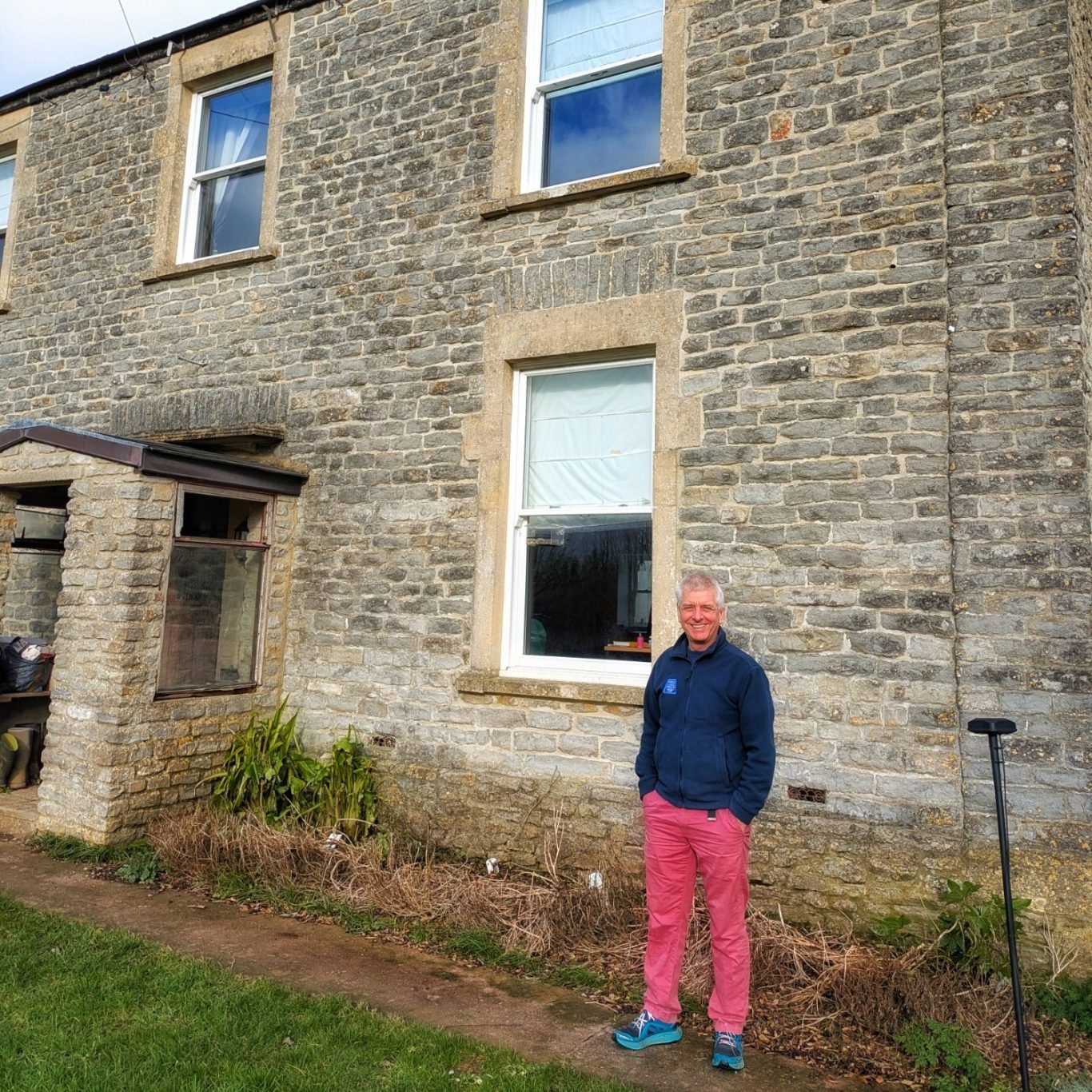
Family home, cheese dairy, maturing rooms – everything is one here: Roger still lives in the house on Bagborough Farm where he grew up.
In addition, the name should have meaning for the people of the region – or tell a story. Tor is named after an iconic landmark. Rachel, on the other hand, tells a love story: a cheesemaker named a cheese after his former lover in order to win her heart. ‘Unfortunately in vain,’ says Roger and laughs. When he compared her to the cheese as nutty and ‘curvy,’ it was game over.
The name White Lake Cheese also refers directly to the surrounding landscape: a water-rich, grass-covered area characterised by pastures, drainage ditches and dairy farming. The White Lake River originates directly on Bagborough Farm – and the milk from its goats is as white as the name suggests.
And as cold as it is, I really want to see it now. On the way back to the station, we stop at the herd: a mixture of British Alpine, Toggenburg and Saanen. Roger unexpectedly heads for a group to our left. ‘Whisper, come here!’ Out of nowhere, his favourite goat appears. ‘A proud specimen,’ he says with a laugh, ‘needs a lot of attention – just like me.’
I ask him if there are moments when he feels concerned. ‘Of course I'm frustrated about Brexit and the raw milk issue,’ he says. ‘But I don't care what the government says anymore. I just do my own thing here.’ And when it all gets too much, he comes here. He ruffles Whisper's head affectionately. ‘Goats are really very good listeners.’
This encounter is part of my ongoing Cheese Stories about international cheese cultures.