11th December 2025
cheese culture
DE version
On Late Awakenings: The Younger Swedish Cheese History with Kerstin Jürss.

The 71-year-old Kerstin Jürss has played a defining role in shaping Sweden’s recent cheese history—as both a cheesemaker and a teacher.
Culinarily and culturally, Sweden is considered a late bloomer in the world of cheese. Well into the 19th century, forestry dominated the economic landscape; a pronounced middle class, let alone larger urban centers, scarcely existed. It was only the profound societal upheavals of industrialization that opened new horizons for the country.
A starting point for Sweden’s modern cheese culture can be found in the mid-19th century: from the 1850s onwards, estates such as Almnäs Bruk took their first steps into local cheese production. And in 1872, according to tradition born of fortunate accident, Västerbottenost emerged in Sweden’s second-northernmost region. Today, the cheese is more than ever considered a cultural treasure—a hallmark of everyday Swedish enjoyment and often part of the traditional appetizer S.O.S., short for smör, ost, sill—butter, cheese, and herring.
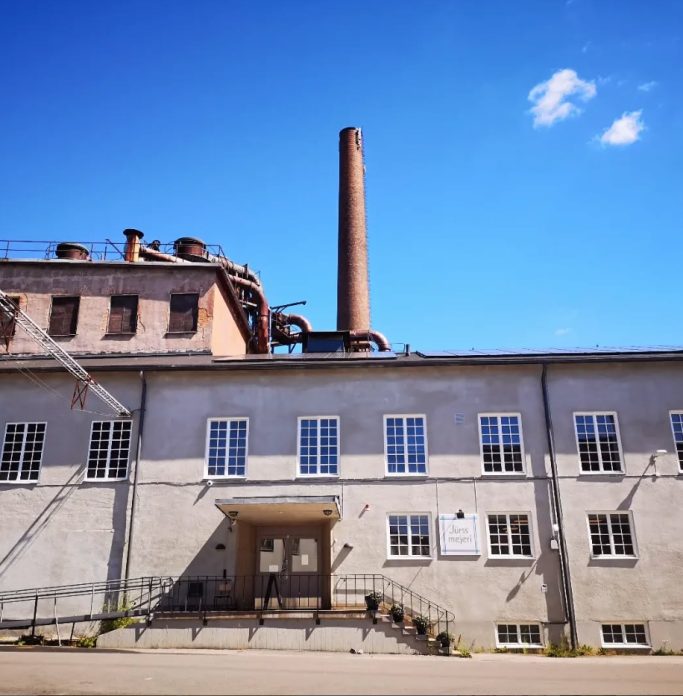
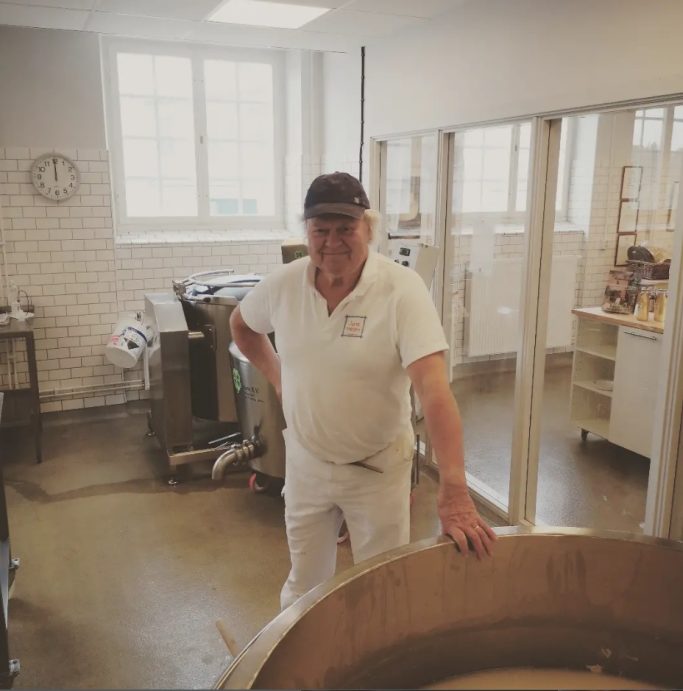
Since 2004 Hälleforsnäs is the center of learning how to make cheese from the best od the best: Kerstin and Claas (r.) Jürss.
The Long Echo of Industrialization.
At the beginning of the 20th century, the first dairies merged into cooperatives; by the 1930s their number had grown to roughly 800 across the country. With the outbreak of the Second World War, however, came an abrupt rupture: the once diverse landscape contracted to a handful of mainly cooperative establishments—a condition that persisted surprisingly long and shaped Sweden’s dairy and cheese industry well into the 1980s.
The culinary preferences of the time reflected the spirit of industrialization: efficiency, reliability, and volume were valued more highly than artisanal skill or depth of flavor. Only when Swedes—now in the mid-1980s—became more affluent, traveled more widely, and discovered other food cultures did this awareness begin to shift. A new cultural zeitgeist emerged: openness, curiosity, and a renewed desire for origin, ethics, and expressive flavor profiles.
No one could describe these developments in Sweden’s young cheese history better than Kerstin Jürss, who has shaped them herself—both as a cheesemaker and as a teacher. Her award-winning cheeses and her commitment to the Södermanland region, to Swedish cheese culture, and beyond are emblematic of a shift in Swedish society: a renewed focus on true craftsmanship, tradition, and, above all, flavor.
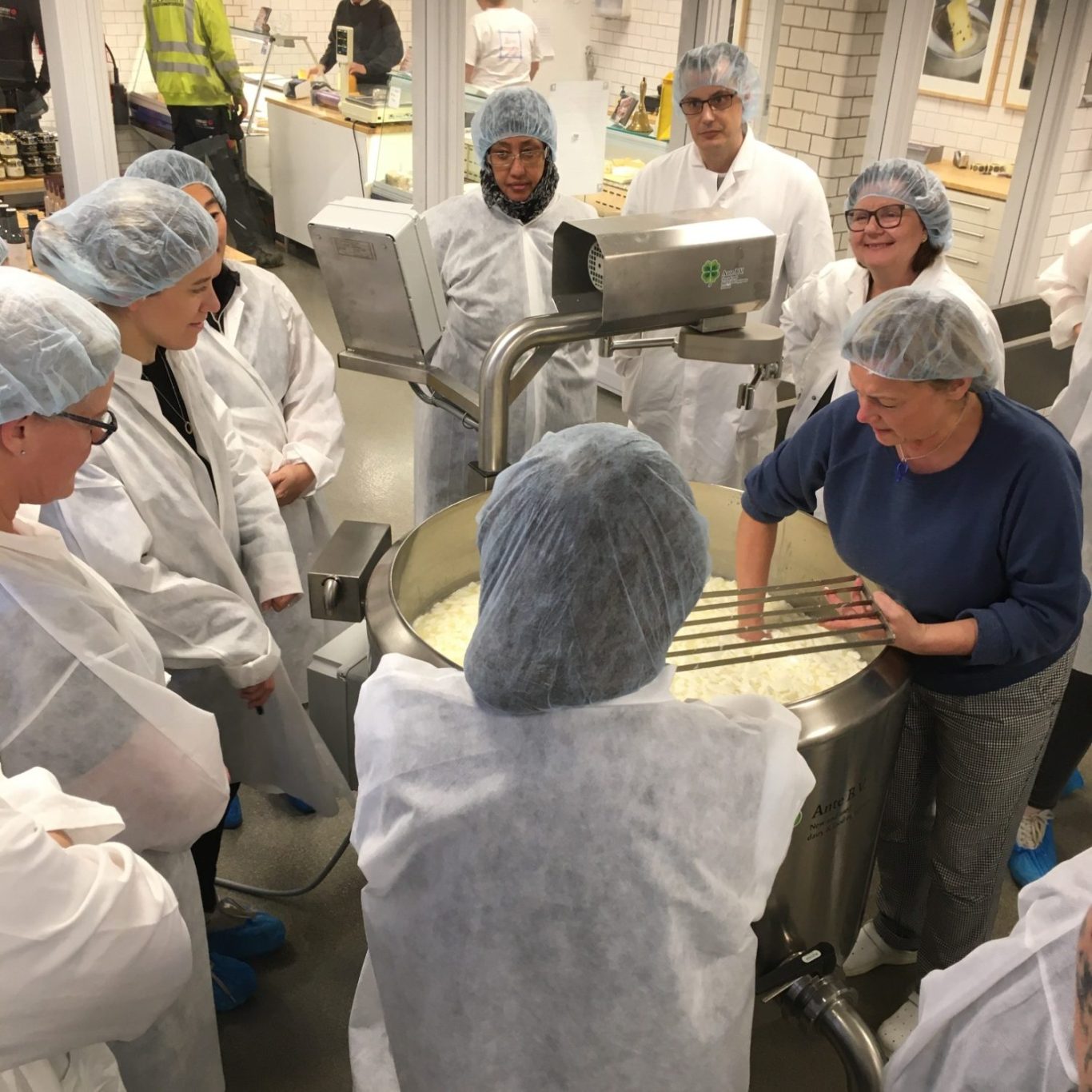
“We were, quite literally, overrun by people from the cities who were searching for meaning, closeness to nature, and manual work.”
From the Strawberry Farm to the Goat Dairy.
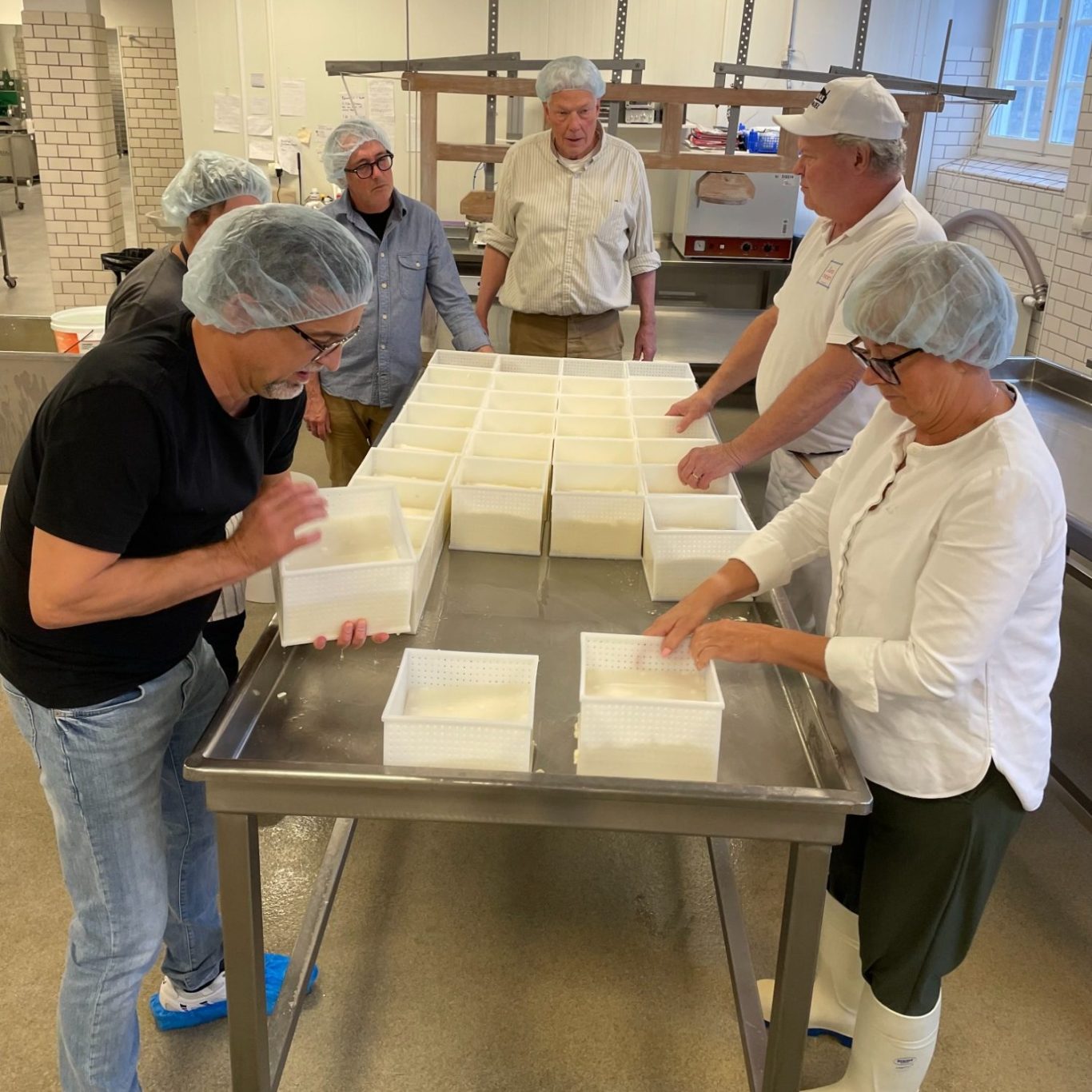
The now 71-year-old Kerstin Jürss met her husband Claas in a skiing resort in Lappland in 1980. Together, they ran other businesses during almost 10 year, one of them was even a strawberry farm! But its pronounced seasonality. In an agricultural high school next to a training center for artisan food production—unremarkable at first, later the foundation of their shared professional path—they learned the craft of goat husbandry—a way less seasonal craft. The goats—and above all their milk—soon became a defining constant in the couple’s life. After a short time, they assumed leadership of the small mejeri that had emerged from the training center and began teaching others the craft of cheesemaking. “It was an era of learning,” Kerstin recalls. “We were, quite literally, overrun by people from the cities who were searching for meaning, closeness to nature, and manual work.”
A Return to Nature, Ethics, and Craft.
What had long been defined by industrial mass production, well into the 1980s, now began to take on a new direction—thanks in part to the work of Kerstin and Claas. Today, Sweden is home to some 150 artisanal dairies. Movements like Slow Food, founded in Italy in 1986, provided additional external momentum to this revived appreciation for nature, tradition, and transparency. They nurtured a way of life that gradually solidified into a cultural stance in Sweden: respect for one’s environment, appreciation of raw materials, and reverence for craftsmanship.
“For the first time, young city dwellers came who were seeking purpose and physical work; people in their mid-thirties looking for a fresh professional start; food enthusiasts who had learned to value provenance and transparency anew,” says Kerstin. This generation, she explains, was more alert, more critical, and more self-assured: “They wanted to understand every step of cheesemaking—and no longer accepted what previous generations had left unquestioned.”
Thus, critical questions moved into the spotlight: Why did supermarket cheese come in a uniform, standardized yellow? And why did so many packages bearing the Arla brand list numerous E-numbers and preservatives?
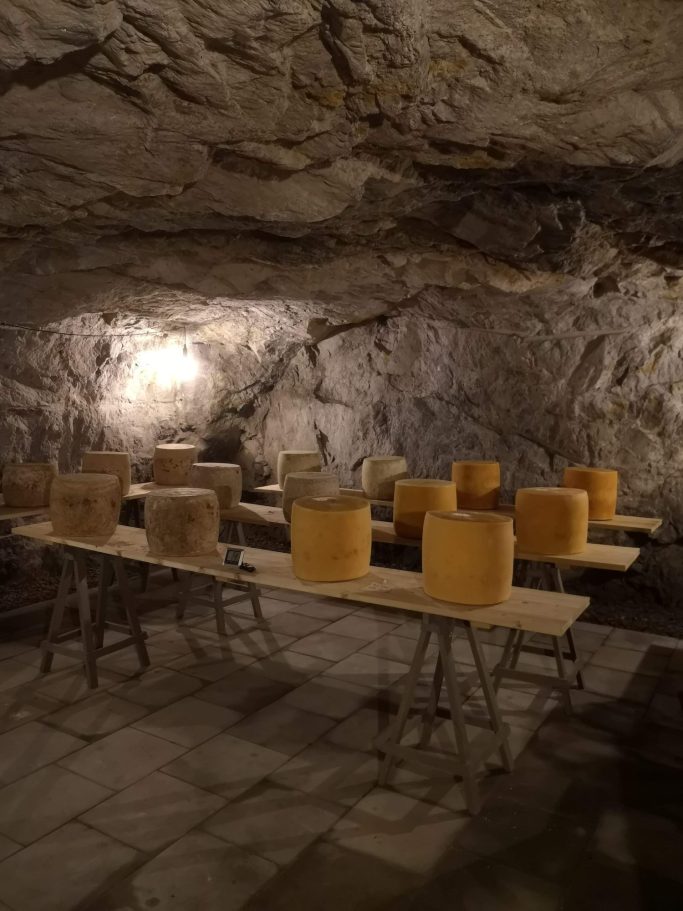
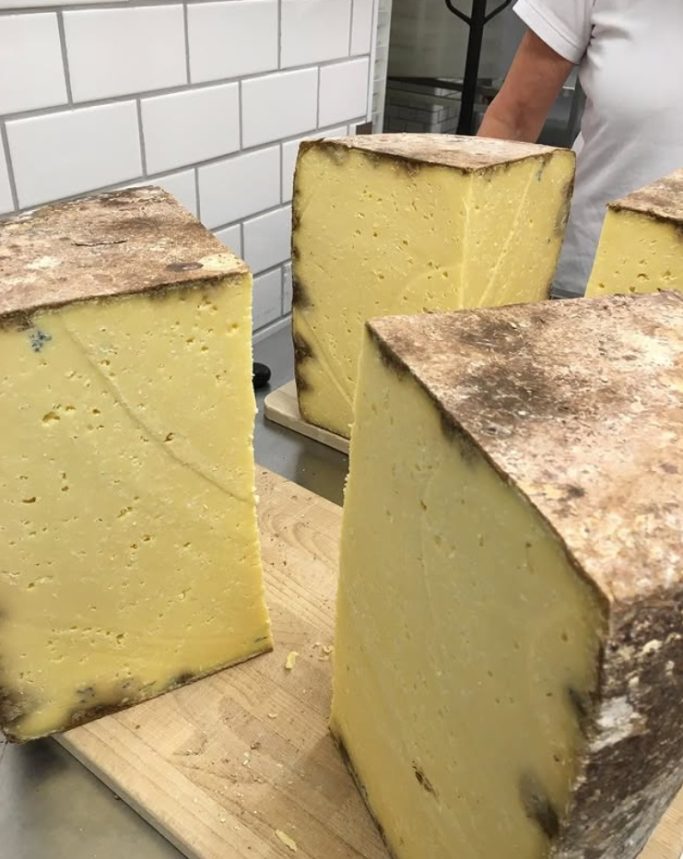
Besides all of their teaching efforts, Jürss Dairy is famous for its artisan cheeses, one of them the Big Ben: an organic, pressed cheese with a wild-flower rind, aged first in the dairy and then for sixteen months in a cave, developing a firm yet slightly creamy texture and a tangy, nutty depth of flavour.
Romanticizing Rural Life.
In 2004, Kerstin and Claas made a decisive move: they stepped away from their role as educators and founded their own dairy in Flen, east of Stockholm—deliberately without keeping their own animals. “Many people romanticize life on a farm,” says Kerstin. “But animals need you 24 hours a day, 365 days a year—and then there’s a mountain of paperwork on top.”
Sourcing regional organic milk gave them the freedom to focus entirely on what mattered most to them: producing high-quality cheese and sharing their knowledge. Proximity to the capital—later intensified by their 2016 relocation to nearby Hälleforsnäs—was no coincidence.
Small-scale food producers, after all, still face profound structural hurdles in Sweden: government support is scarce, shipping relies largely on regular parcel services—expensive, unreliable, and risky. Even acquiring small quantities of milk often fails for lack of logistics. Many farm dairies therefore sell almost exclusively on local markets; the path into cheese counters in Stockholm, Gothenburg, or Malmö remains arduous.
“For the first time, young city dwellers came who were seeking purpose and physical work; people in their mid-thirties looking for a fresh professional start; food enthusiasts who had learned to value provenance and transparency anew,”
Natural and Logistical Dispersion.
The causes lie deep in the country’s structural transformation. After the Second World War, Sweden developed at a breathtaking pace into one of the world’s leading industrial nations—accompanied by rapid urbanization. Today, only about 11 percent of the population lives in rural areas; in Germany the figure is roughly 22 percent. The result is a country of stunning natural beauty paired with equally stunning logistical dispersion.
This makes Kerstin and Claas all the more appreciative of initiatives such as the Nordic Cheesemongers, who since 2019 have worked to bring Nordic cheeses onto the international stage—an ambitious yet vital undertaking in a country where even national distribution poses a challenge.
Expressive Flavor Profiles.
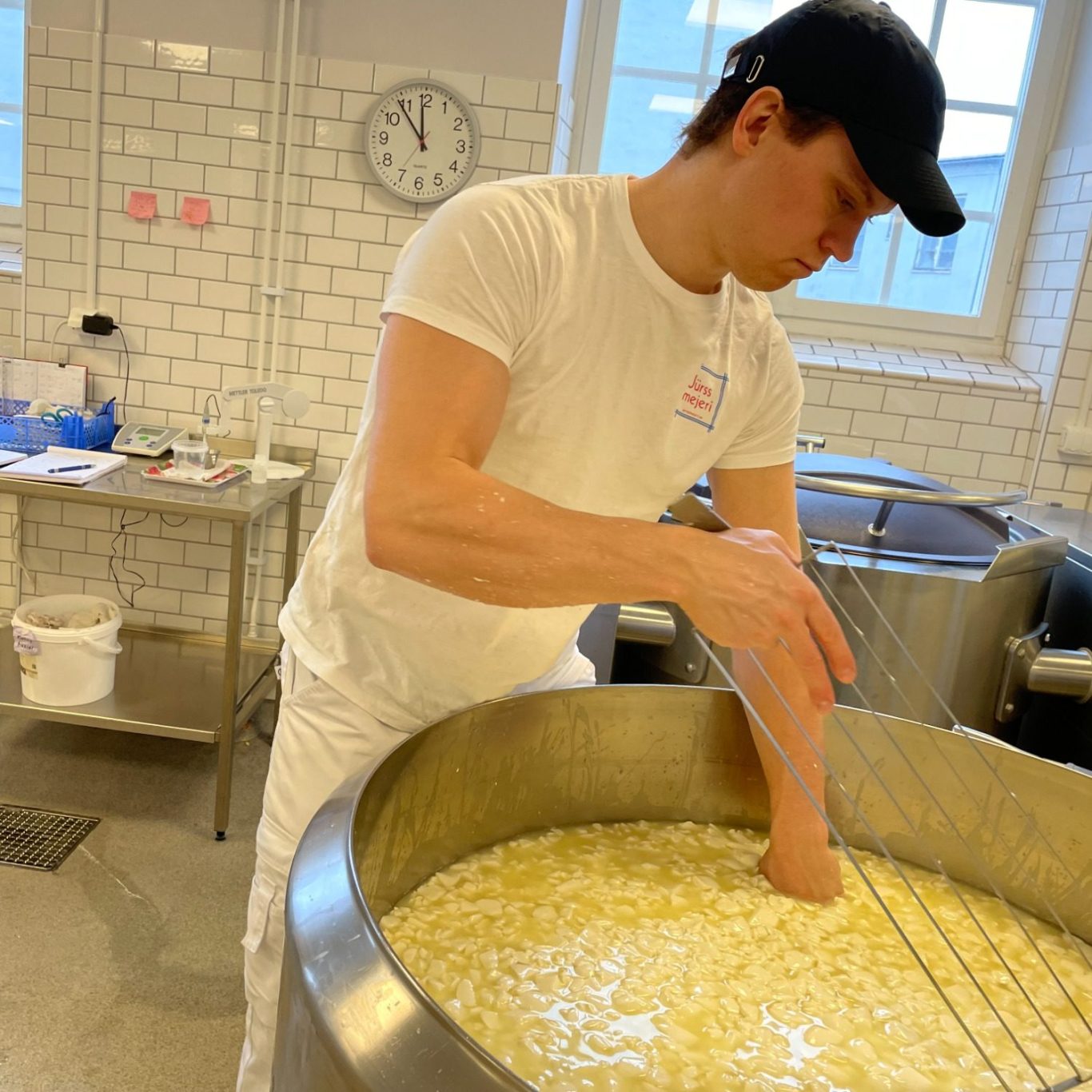
Today, Jürss Mejeri processes around 4,000 liters of milk per week. Annual production is intentionally limited to 18 to 20 tonnes. Every wheel is cared for by hand; many mature on microbially active wooden shelves that develop depth, musky nuances, and aromatic complexity.
The fact that their cheeses achieve such layered, expressive profiles despite being made from pasteurized milk is regarded as a testament to precise craftsmanship—and to a raw-material intuition honed over decades. Many of their former trainees now run their own dairies; several significantly shape the country’s contemporary cheese landscape.
“We continue to support our son with advice and hands-on help. Cheese is our life—the craft is not work but a philosophy of living.”
A Generational Shift.
Their geographical distribution is striking: while Götaland and Svealand—more densely populated and well connected—host numerous dairies, the vast, sparsely populated Norrland is home to an unusually high number of goat-focused operations. Whether this relates to the traditionally produced, caramel-brown Mesost of northern Jämtland cannot be said with certainty. What does stand out in comparison with other European countries: domestic sheep’s-milk production in Sweden still plays only a marginal role.
At present, however, Kerstin and Claas are most occupied by the coming generational transition within their own business. Their son Karl is taking on increasing responsibility. Yet Kerstin is not thinking of retirement: “We continue to support our son with advice and hands-on help. Cheese is our life—the craft is not work but a philosophy of living. I am grateful to have witnessed and helped shape the rediscovery of Swedish dairy craftsmanship.”
Jürss Mejeri
Gjutmästarbacken 1, 648 31 Hälleforsnäs, Sweden
website: www.jurssmejeri.se
instagram: www.instagram.com/jurssmejeri