14th May 2026
Cheese Stories
German version
Tenuta Vannulo: Premium Mozzarella di Bufala Campana PDO, crafted by Michele, Donato, Pasquale and Marco
This Cheese Story is based on a meeting with the four cheesemakers Michele Liberti, Donato Brenca, Pasquale Cuiccio and Marco Mantono from Tenuta Vannulo, in the heart of Paestum in Campania. It showcases a prime example of the artisanal production of Mozzarella di Bufala Campana PDO – a large-scale production facility whose products are sold exclusively within the region. It complements Caseificio Starace’s Cheese Story by offering a comprehensive overview of the southern Italian art of cheese-making, focusing on pasta filata specialities.
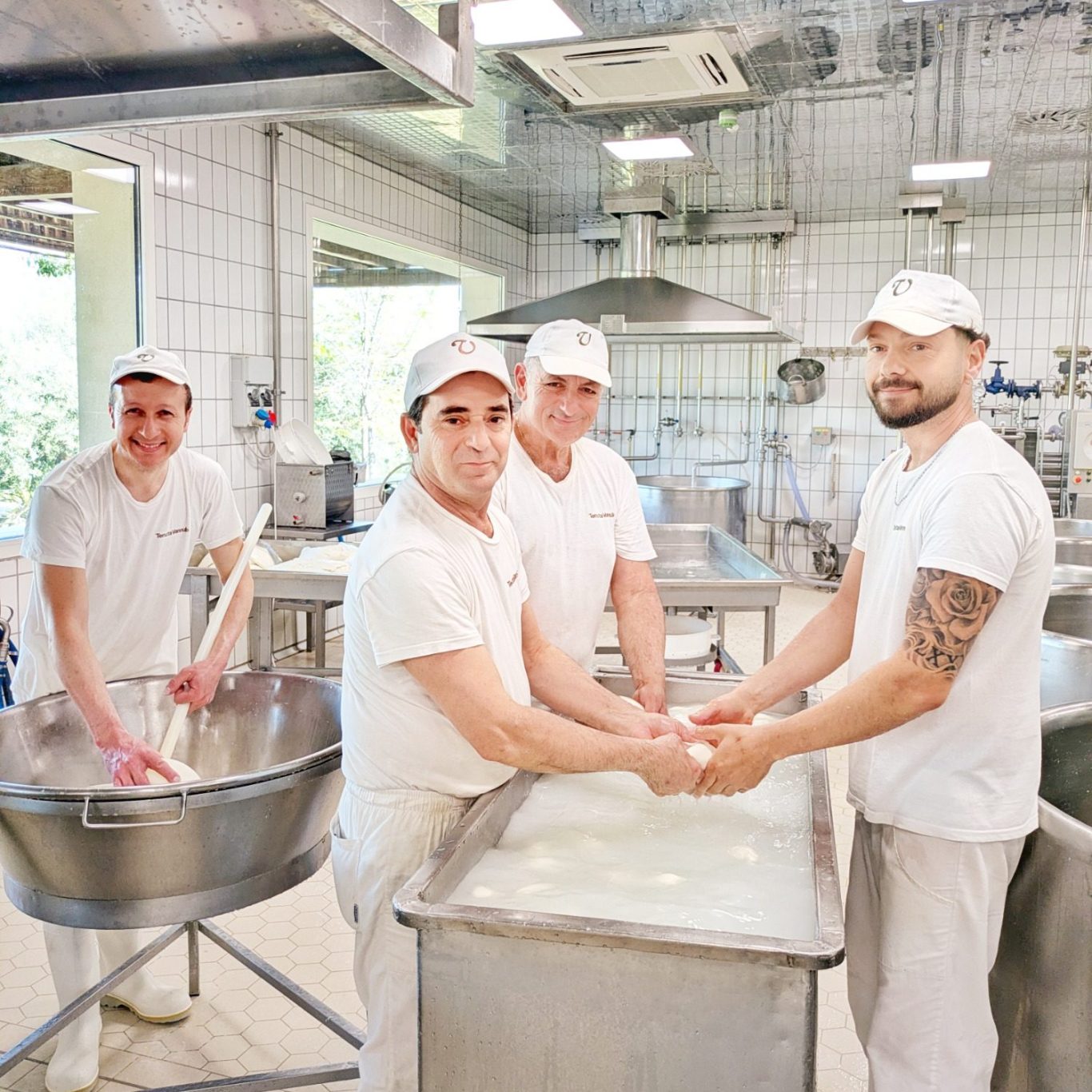
For more than 25 years, the eight driving forces behind Tenuta Vannulo’s cheese-making craft: Michele Liberti, Donato Brenca, Pasquale Cuiccio and Marco Mantono (from left)
“You’ve never been to Tenuta Vannulo?” When I visited her organic farm, Bobalis, in Jüterbog, Elke Henrion could hardly believe that, during my year-long journey through Europe in search of cheese, I had never visited “the” famous southern Italian producer of Mozzarella di Bufala Campana DOP. “Vannulo has been a major inspiration for what you see here. And still is to this day.” Zugegeben: It is rather unusual to come across a herd of 150 water buffalo here, in the heart of the Teltow-Fläming district.
The inspiration that emanates from the Campanian destination of Vannulo must therefore be immense. And the superlatives – as became clear even as I was planning my trip to the Amalfi Coast just six weeks later (yes, Elke’s enthusiasm left me with little choice but to book straight away) – were almost too numerous to count during my visit.
And yet I set off with a host of critical questions in mind: with 30,000 visitors a year – including guests from the USA, Switzerland, Germany and Japan – can one really still call this an artisanal workshop? Given a herd size of 600 animals, how consistently is animal welfare actually practised? And to what extent is the art of cheese-making still the main focus, given that, since Antonio Palmieri began producing buffalo mozzarella in 1988, a Museo della Civiltà Contadina, a yoghurt shop, a bakery and leather goods shops have also opened? Is this really still about cheese?
On my train journey on this late April morning from Naples to Paestum, the slopes of Monte Soprano roll past me. My gaze lingers briefly on the Madonna del Granato pilgrimage church in Capaccio, dedicated to the ‘Mother of the Pomegranate’: dating from the mid-10th century AD, it stands enthroned on the headland of Monte Calpazio, overlooking the entire plain, where there is a remarkable depth to be discovered, not only in terms of the landscape but also historically.
Far from a given
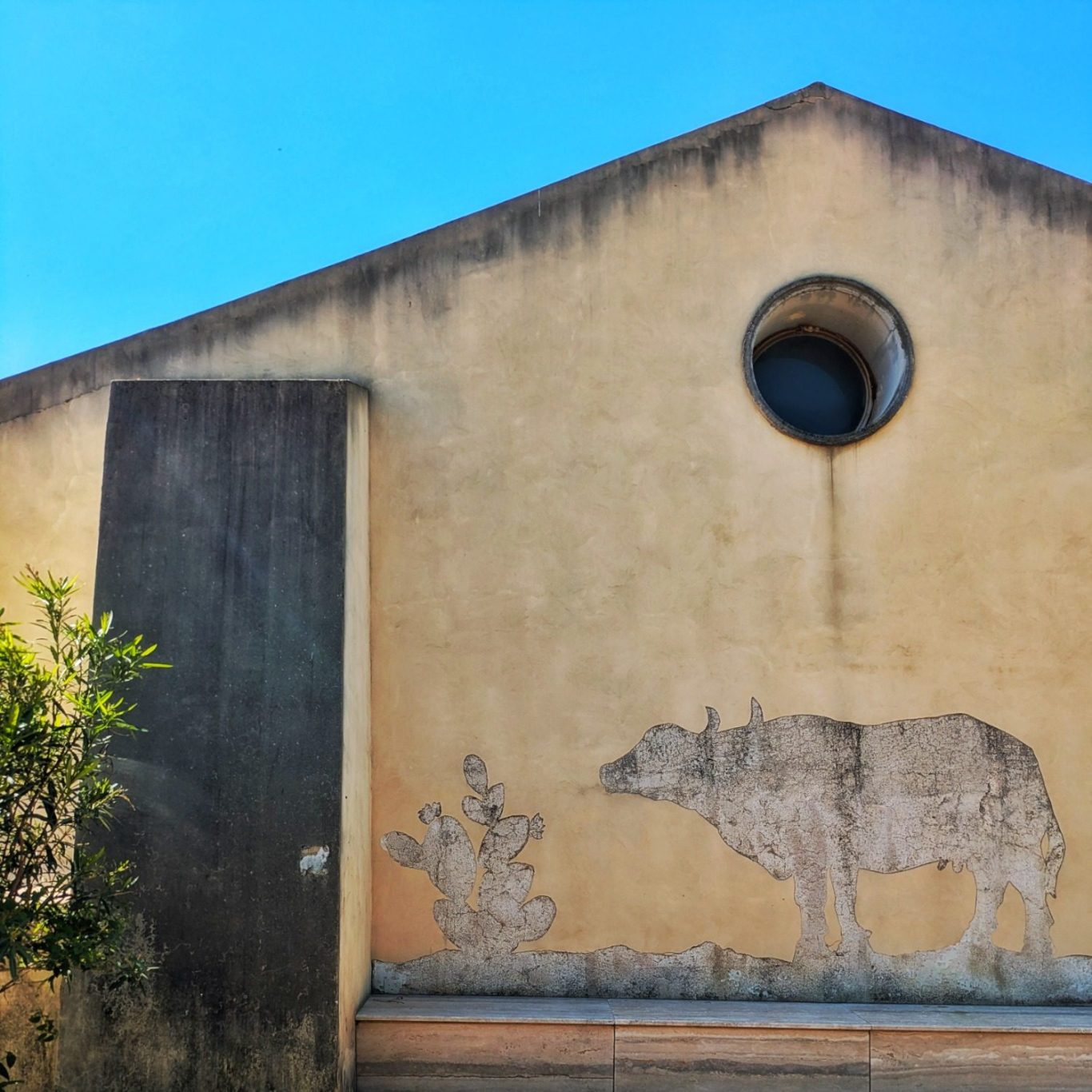
History brought the Asian water buffalo to the marshy region around Paestum.
The olive grove lining the path to Tenuta Vannulo – which means ‘estate’ – welcomes me as one of the many guests this morning; and it is only nine o’clock. Before my appointment at the cheese dairy, I would like to get at least a first impression of these special surroundingsn – a place that is now regarded as a prime example of how buffalo milk is processed into various pasta filata specialities. And yet, historically speaking, this is anything but a given.
For why is it that the landscape between Naples and Salerno, shaped by Vesuvius and the Tyrrhenian Sea, is so closely associated with this particular type of cheese? And how did the water buffalo, originally from Asia, end up here? In short: the animals were put to work and brought to the marshy plains around Paestum – hardy, adaptable and perfectly suited to this landscape. Work animals eventually became milk suppliers; necessity gave rise to variety: mozzarella, burrata and, over time, matured pasta filata cheeses such as provolone and caciocavallo. Here, at Tenuta Vannulo, the focus has always been on the daily production of fresh Mozzarella di Bufala Campana DOP.
In 1907, the family – led at the time by Antonio Palmieri, the grandfather of the current owner – began to “combine agriculture, nature and culture with consistency, dedication and a sense of responsibility” at this location. At least, that is how the estate’s own website describes it. Before me stands the original farmhouse, a testament to the long family and artisanal history of Tenuta Vannulo. It is still home to Antonio, his wife Caterina and their children Teresa, Nicola and Annalisa.
„We're the whole team!“
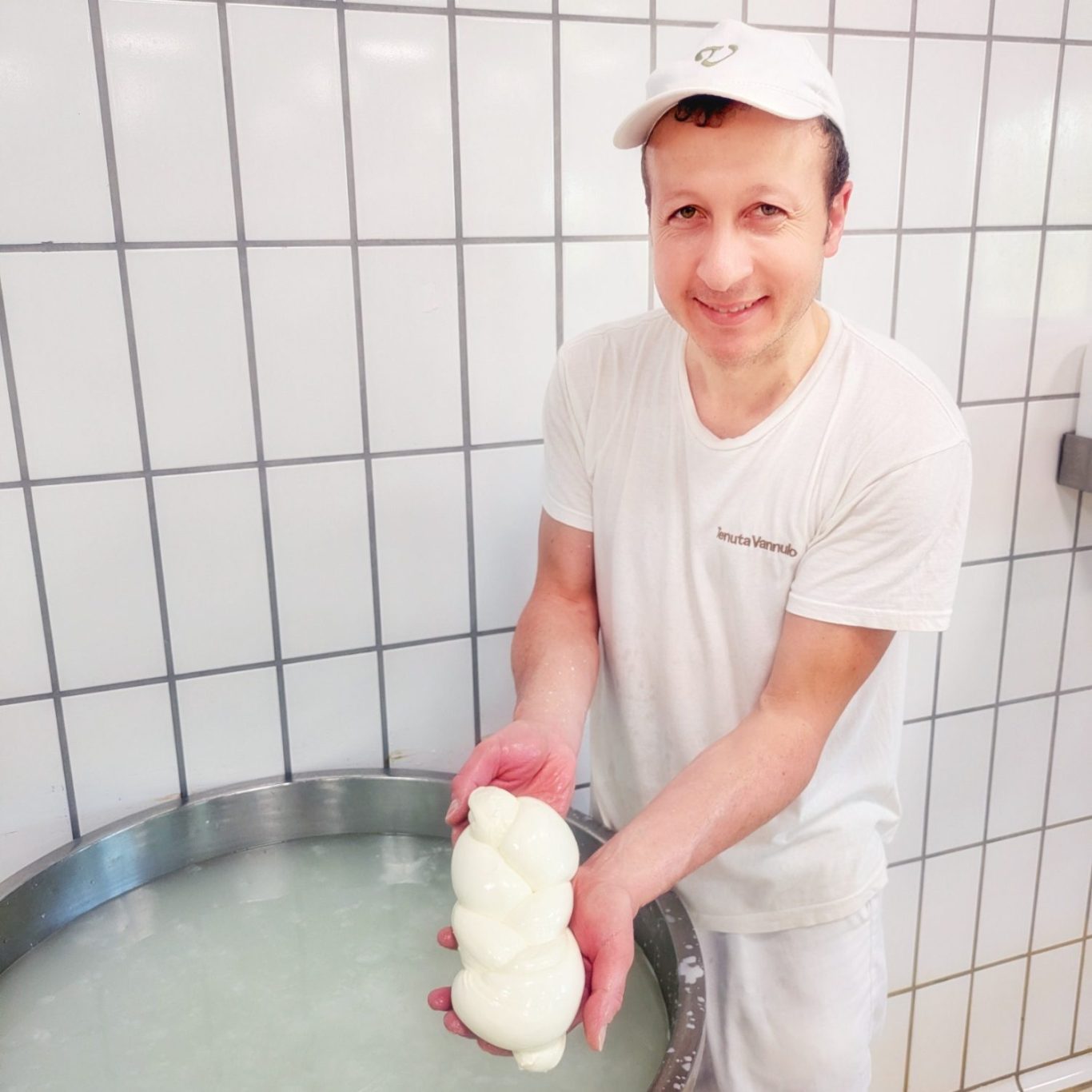
Michele's "giant mozzarella plait" is braided in a matter of seconds.
The fact that Vannulo is now home to one of Italy’s most renowned organic buffalo farms is largely down to Antonio. In 1988, when he was in his early twenties, he began producing cheese on his grandfather’s farm – and it has been at the heart of the family business ever since. Over the years, the complex of buildings has visibly grown around this production, supplemented by cultural and culinary workshops. To this day, sales take place exclusively at the Tenuta, which explains the large number of visitors from the region, given the early hour.
Through the light-flooded windows, I was able to catch a first glimpse of the cheese dairy as soon as I arrived. But now, right in the thick of things, I am particularly impressed by the high-quality equipment, the height of the room – or rather the hall – and, even more so, the four beaming faces that give me a warm welcome. Michele Liberti, Donato Brenca, Pasquale Cuiccio and Marco Mantono are the men in their mozzarella-white Vannulo uniforms who are responsible for the entire cheese and ricotta production here.
“And how big is the team in total?” I ask the group. Michele laughs out loud. “Siamo l’intera squadra!” – we are the whole team. Are there really only eight people working here in the cheese dairy?“Yes, there are now 80 of us on the estate. But the cheese-making is something that Donato, Pasquale, Marco and I handle ourselves.” Every day, the four of them process several thousand litres of raw milk, depending on the season. Their buffalo milk specialities never see the inside of a fridge.
Although all four have been working here for more than 25 years, they never seem to tire of showcasing their craft with pride and obvious passion. “Shall I plait you a gigantic mozzarella plait?” How could I possibly refuse such a request from a proud Italian like Michele? In the truest sense of the word, Michele pulls the cheese dough into a long strand in a matter of seconds and, with practised ease, braids it into a mighty plait. “Buon appetito!” he laughs, holding out his forearm-length masterpiece to me with a beaming smile.
Fully automated, at scale, adding value
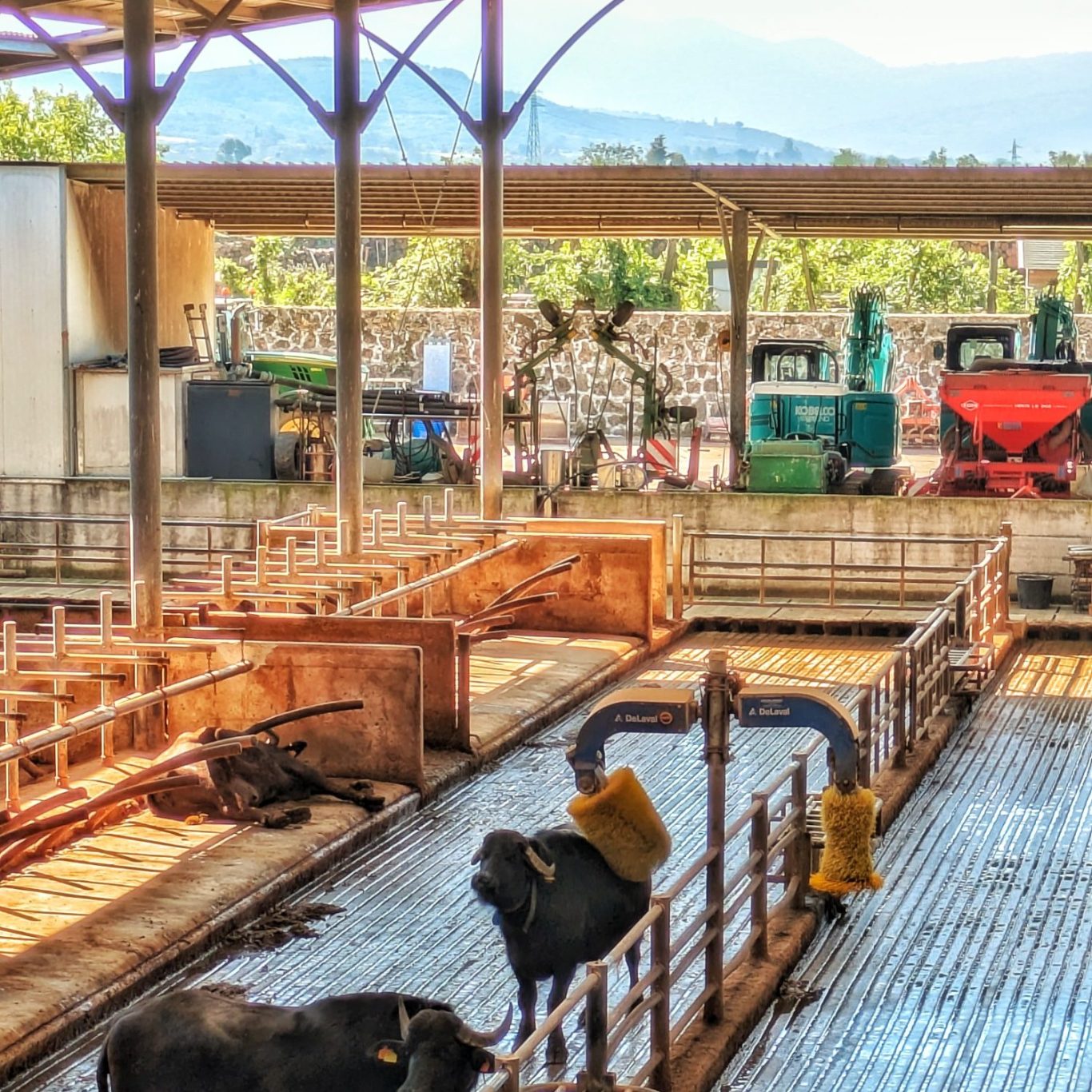
Brush massage accompanied by Mozart: the wellness programme for the 600-strong herd at Tenuta Vannulo.
I step out into the spring afternoon, which has now warmed to 25 degrees. The terrace seating outside the Yogurteria is packed to the rafters. The house specialities – which, alongside the cheese creations, include savoury and sweet baked goods as well as yoghurt, custard and ice-cream specialities – are served in no particular order on the guests’ plates. What interests me most, however, is the area behind the building:Around 150 hectares of stables and pastureland, home to 600 buffalo – including 300 dairy buffalo – and the site of organic arable farming with on-site feed production.
The spacious winter stables make even this large herd seem almost invisible. Unlike on many other farms, the animals here are not kept in cramped conditions. Rather, the buffaloes themselves decide – even in this airy, light-filled enclosure – whether, after their morning dose of Mozart, they’d prefer a massage and a fully automated brushing, or whether, as I witnessed a little later in an almost surreal scene, they’d rather wait patiently in line for the automated milking robot from Sweden.
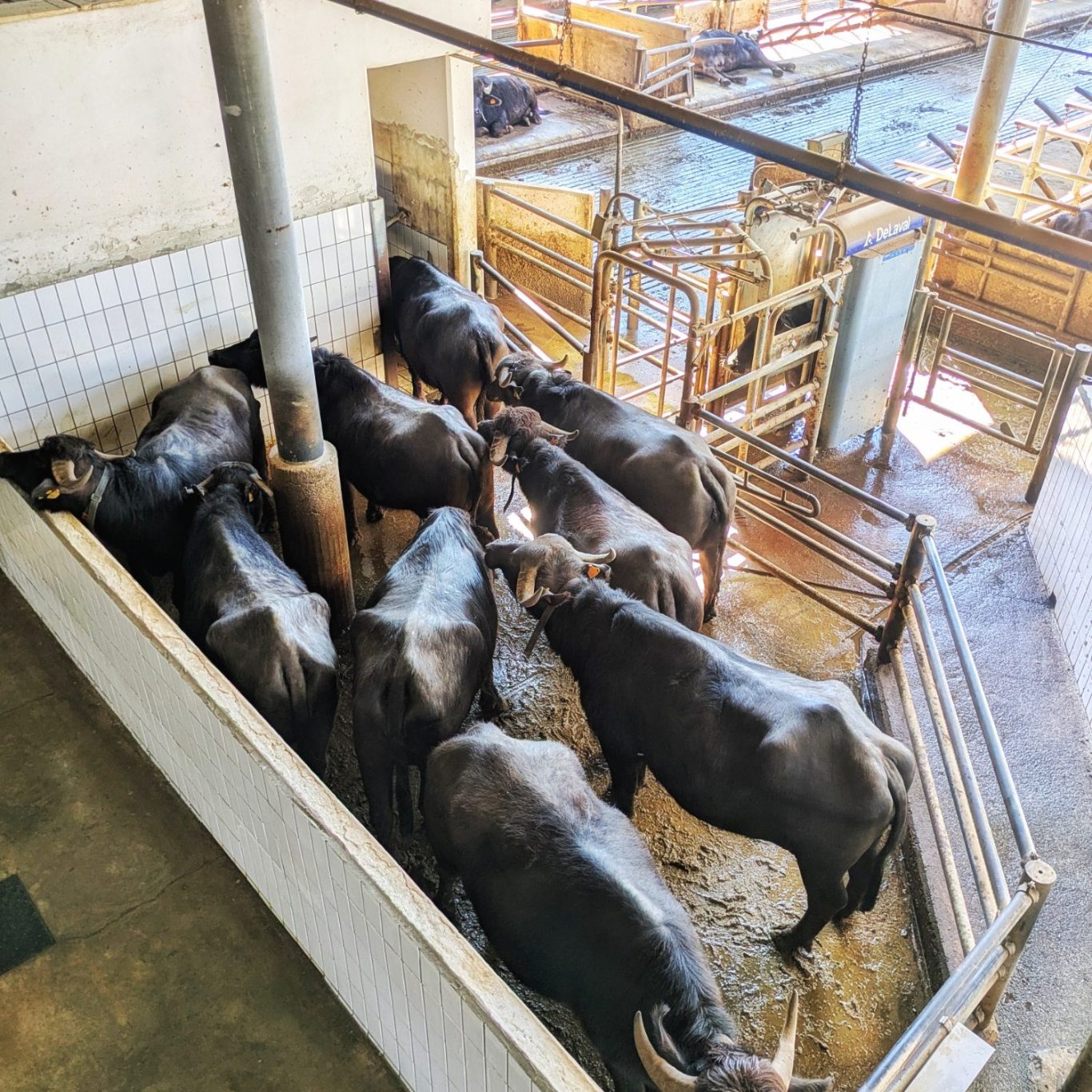
A surreal sight: a queue forming in front of the fully automated milking robot, featuring the latest technology from Sweden.
A voluntary milking system has been in place here since 2008, allowing the animals to decide for themselves when they wish to be milked. The system operates round the clock, using an electronic chip attached to the animals’ ears in combination with a 3D camera. Not only animal welfare, but also hygiene considerations and the immediate testing of milk quality – changes in the microflora are detected straight away – contribute here, alongside the farm’s own organic feed, to the best possible cheese quality.
Tradition meets innovation. State-of-the-art technology combined with regional value creation. Elke Henrion certainly did not overpromise: at Tenuta Vannulo, the artisanal production of Mozzarella di Bufala Campana DOP is taken to the highest possible standards, with the utmost attention paid to quality and animal welfare – scaled up, as far as the eight hands of Michele, Donato, Pasquale and Marco can manage. For the exclusively regional marketing of a top-quality Mozzarella di Bufala Campana DOP around Paestum. Shining brightly, far beyond the Amalfi Coast – at least as far as Jüterbog..
This encounter is part of my ongoing Cheese Stories on international cheese cultures.